
What’s a Turnkey Studio Build-Out and What's Commonly Included?
A turnkey studio build-out is a complete lifecycle engagement where a single broadcast engineering partner takes a raw or partially developed space and delivers a fully operational broadcast or recording facility: acoustics, mechanical systems, technical infrastructure, equipment, and crew training all included. When the keys change hands, the studio is ready to go live. Nothing is left for the client to chase down, coordinate, or commission separately.
That operational difference matters more than it might initially appear. Media facility projects have a long history of collapsing under the weight of fragmented subcontractor relationships, where the acoustic consultant's drawings contradict the HVAC engineer's duct routing, and the AV integrator shows up to a room that was never built to the signal specifications they were handed. A true turnkey model eliminates that structural vulnerability by placing every phase of the project under one accountable partner.
This piece covers what a turnkey studio build-out includes, phase by phase, from the initial acoustic and architectural design through equipment integration, commissioning, and crew training. If you're a technical director, enterprise media head, or executive producer evaluating how to build a high-performance facility without managing a dozen disconnected contractors, this is the breakdown you need.
Defining the Turnkey Studio Build-Out Model
In the broadcast and media production world, "turnkey" carries a specific operational meaning that goes well beyond its casual use in real estate or franchise contexts. A turnkey studio build-out means a single point of responsibility covers the entire project lifecycle: from acoustic modeling and architectural planning through equipment procurement, rack fabrication, signal path commissioning, and final staff training. The client defines performance requirements upfront; the broadcast engineering partner executes every phase to meet them.
The contrast with traditional design-bid-build methods is structural, not just procedural. In a conventional fragmented approach, an owner hires an architect, separately engages an acoustic consultant, solicits bids from AV integrators, and coordinates a general contractor who has never built a broadcast facility before. Each party optimizes for their own scope. When the acoustic consultant's floating floor specification conflicts with the structural engineer's load calculations, or when the electrical contractor runs conduit through a wall that was supposed to be acoustically isolated, the client absorbs the cost of the conflict. Nobody owns the problem because nobody owns the whole project.
Going turnkey does not mean surrendering control over design decisions or equipment selection. The client still defines what the facility needs to do: format, workflow, channel count, production style, redundancy requirements. What shifts is who bears the burden of translating those requirements into a coherent, buildable, and functional design. A capable broadcast engineering partner like TV Pro Gear, operating under the engineering leadership of Andrew Maisner, takes that burden entirely. The team designing the acoustic isolation is the same team specifying the signal routing, which is the same team installing the equipment and training the crew. There are no gaps in the project where a coordination failure can hide. That is the turnkey advantage.
There is a cost objection worth addressing honestly. Turnkey contracts typically include a built-in risk premium, as the broadcast engineering partner prices in the coordination complexity they are absorbing. Managing separate architects, acoustic consultants, and AV integrators yourself can look cheaper on paper at the proposal stage. In practice, the coordination failures that emerge in multi-contractor builds almost always generate expensive rework, delayed launches, and performance deficiencies that require post-occupancy remediation. The industry pattern is well-documented even if precise overrun figures vary by project: fragmented builds fail at the handoff points between disciplines, and those failures are rarely cheap to fix.
What Is Included in a Turnkey Studio Build-Out Project Scope
A professional studio build-out is fundamentally an environmental engineering problem before it is an equipment procurement problem. Sound, light, power, and signal routing all have to work in concert within a physical space that was probably designed for something entirely different. A specialized broadcast engineering partner coordinates the architectural, mechanical, electrical, and technical phases under a single project manager; this means the person managing the acoustic ceiling specification is also tracking the cable pathway drawings and the equipment delivery schedule.
The principle of operational readiness is the clearest way to define what a complete turnkey project scope delivers. Operational readiness means the physical space, the technical systems, and the operating crew are all fully prepared for live production simultaneously. A studio where the equipment works but the crew doesn't know how to run it isn't operationally ready. A studio where the crew is trained but the acoustic treatment hasn't been calibrated isn't operationally ready either. Both elements must align. Every phase in the scope below feeds that single outcome. We build for live production.
A standard turnkey studio build-out project scope covers these core phases:
- Acoustic and Architectural Design: Complete space planning, sound isolation modeling, and aesthetic design tailored to broadcast or recording requirements, including room-within-a-room construction strategies and surface treatment layouts optimized for the intended production format.
- Mechanical and Electrical Engineering: Specialized HVAC silencing systems, isolated electrical grounding, and dedicated power distribution designed from the ground up to eliminate the technical noise that standard commercial construction introduces.
- Technical System Integration: Procurement, wiring, rack fabrication, and full configuration of all audio, video, and control systems, executed to broadcast-grade standards, not general AV specifications.
- Commissioning and Tuning: Rigorous signal path verification, acoustic calibration, and system optimization conducted before the facility is handed over, not after the first live broadcast reveals a problem.
- Crew Readiness Training: Hands-on operational training delivered by engineers who have operated the systems in live production environments, ensuring the client's staff can run the facility confidently from day one.
Professional Studio Design and Engineering Services
The bulk of critical cost and performance decisions in a studio build-out are locked in during the design phase. Late-stage changes, such as revising an acoustic isolation strategy after framing is complete or rerouting power distribution after the electrical rough-in is done, are exponentially more expensive than getting those decisions right at the drawing stage. This is the phase where an experienced broadcast engineering partner earns the most value, and where a generalist architect or contractor creates the most risk. Design dictates performance.
Specialized acoustic engineering prevents a category of structural failures that general contractors simply do not encounter in commercial construction. Flanking noise, which is sound that bypasses an isolation barrier by traveling through structural connections like floor joists, wall studs, or HVAC ductwork, is one of the most common and costly problems in amateur studio builds. Modal resonances, which occur when a room's dimensions create standing wave buildups at specific frequencies, can render a mixing environment acoustically unreliable regardless of how expensive the monitoring equipment is. HVAC rumble, introduced when high-velocity airflow creates turbulence in undersized duct runs, produces a broadband noise floor that no amount of post-processing can fully remove. Addressing all three requires a building envelope approach: an acoustically isolated structure built within the existing shell of the building, decoupled from the surrounding construction at every structural contact point.
Professional broadcast and recording environments require exceptionally low Noise Criterion ratings to achieve the silent noise floor that sensitive microphones and monitoring systems demand. Meeting those targets means engineering HVAC systems with large-diameter duct runs, low-velocity airflow, and acoustic baffles at every transition point: systems that look nothing like the standard commercial HVAC a general contractor would specify. The velocity reduction required to achieve near-silent airflow delivery demands duct cross-sections far larger than a typical commercial installation, which in turn affects ceiling heights, plenum space allocation, and structural coordination. None of this is intuitive to a contractor whose experience is in office build-outs or retail spaces. Broadcast requires specialized expertise. It requires engineers who have designed these systems before and understand how the acoustic, mechanical, and structural requirements interact.
The specific design and engineering deliverables a client should expect in a complete system lifecycle scope include:
- Structural soundproofing details covering double-wall construction, floating floor assemblies, and acoustically decoupled ceiling systems engineered to the target isolation rating.
- Detailed acoustic treatment layouts specifying absorber placement, diffuser positioning, and bass trap sizing calibrated to the room's modal profile and intended use.
- Electrical schematics featuring isolated technical grounds and dedicated power panels engineered to prevent ground loops and eliminate the hum that plagues facilities wired to standard commercial electrical specifications.
- Mechanical drawings for silenced HVAC systems, including duct sizing calculations, baffle specifications, and air handler placement designed to meet the target noise criterion for the space.
- Detailed signal flow diagrams mapping every audio, video, and control connection in the facility, forming the document set that makes the system maintainable and expandable for years after handover.
"TVPG are the hardest working, most efficient, professional, and friendly vendors that I've ever worked with." - Connie Cochran / City of Stockton
Audio and Video Studio Equipment Integration
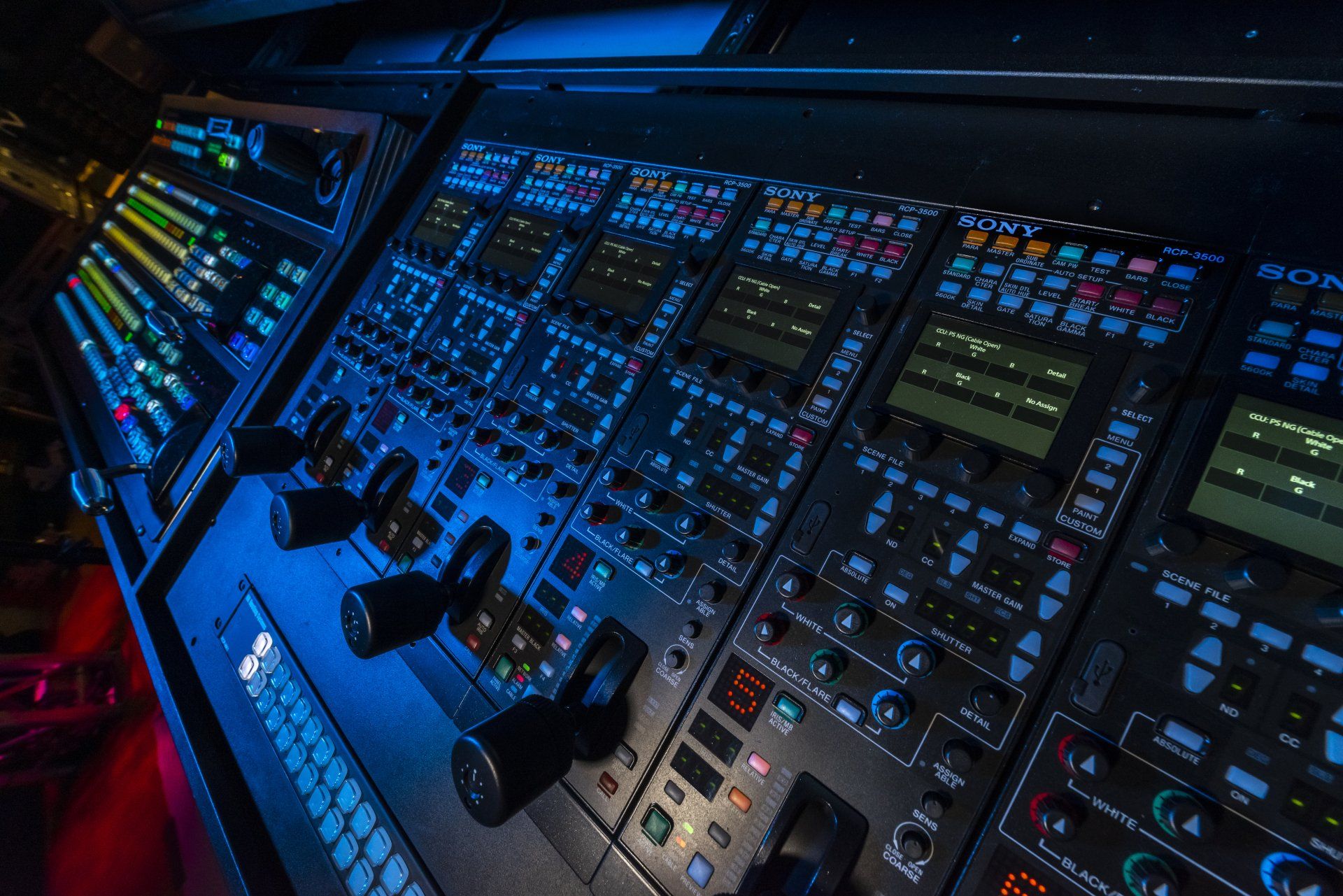
Contemporary broadcast systems integration carries a level of technical complexity that scales quickly with production ambition. Every signal path matters. HD and 4K workflows demand high-bandwidth signal paths, precision timing infrastructure, and routing architectures that can handle simultaneous multi-source feeds without introducing latency or synchronization errors. High-speed fiber transmission has replaced much of the coaxial infrastructure in contemporary facilities, but the transition introduces its own set of compatibility and configuration demands that require hands-on expertise to navigate correctly.
Think of signal routing like a highway interchange during a live broadcast: one misconfigured lane and traffic backs up across the entire feed. A single incorrect routing assignment in a production switcher, a mismatched fiber transceiver, or an improperly terminated connector can cascade into a complete signal failure at the worst possible moment. A turnkey broadcast engineering partner mitigates that risk by pre-fabricating equipment racks in a controlled shop environment, labeling every cable systematically according to a documented naming convention, and testing every signal path fully before the equipment ships to the site. By the time installation begins, the system has already been proven. We eliminate on-site guesswork. On-site work becomes a matter of connection and verification rather than troubleshooting and discovery.
That pre-fabrication discipline also produces a cleaner, more maintainable facility. A rack that was assembled and tested in a shop environment, with every cable bundled, labeled, and routed according to a documented plan, is a rack that a technician can service at 2 a.m. during a live event without guesswork. The difference between a professionally integrated system and a field-assembled one shows up most clearly under pressure, which is exactly when it matters most. Clients who have worked with TV Pro Gear consistently note the difference that level of preparation makes. As Scott from BackStageGuest.com / Five Finger Death Punch put it: "TV Pro Gear are amazing! They are second to none!"
Ready to discuss your facility's signal architecture? Call TV Pro Gear at (818) 246-7100 to talk through custom flypack configurations, video truck builds, or fixed studio integration projects.
Studio Commissioning and Training Services
Equipment that is powered on differs fundamentally from a system that has been fully commissioned. Powering on is not enough. Commissioning is the systematic process of verifying that every component, signal path, and subsystem performs according to its engineered specification: not just that it turns on, but that it delivers the correct output at the correct level, with the correct timing, under the load conditions it will face in production. Skipping or shortcutting this phase is one of the most common ways a technically sound facility design produces an unreliable operational result.
The commissioning and training phase of a turnkey build-out covers:
- System Commissioning: End-to-end verification of all AV and broadcast systems against the engineered specifications, including signal path testing, level calibration, routing verification, and redundancy failover confirmation.
- Acoustic Tuning: Calibration of monitor speakers and DSP processing systems to match the room's measured acoustic profile, ensuring that what engineers hear in the room accurately reflects the signal they are working with.
- Crew Readiness Training: Hands-on operational training led by engineers with live broadcast experience, covering normal operation, fault recovery, and workflow-specific procedures for the client's production format.
- As-Built Documentation: Delivery of complete, updated signal flow diagrams, cable run lists, rack elevations, and equipment manuals reflecting the system as it was installed, not as it was originally designed, which often differs in meaningful ways.
- Post-Handover Support: Ongoing technical assistance and maintenance with a defined path for support, so the client is never left without recourse when questions arise after the integration team has left the site.
The core engineering principle behind TV Pro Gear's approach to this phase is clear: a sophisticated broadcast system is only as good as the crew operating it. A facility with a $500,000 technical infrastructure and an undertrained staff will underperform a simpler, well-understood system every time. That's why a dedicated staff coordinator manages the training schedule and ensures the client's team is genuinely comfortable with the new workflows, not just walking through a checklist, before the first live transmission. The training is led by engineers who have run live broadcasts on the same types of systems, meaning the instruction is grounded in operational reality rather than manufacturer documentation.
The contrast with transactional equipment brokers is stark. We stay until it works. A vendor who ships equipment, supervises a basic installation, and disappears leaves the client with a complex system and no institutional knowledge of how to run it. When something goes wrong during a live event, and in broadcast, something always eventually goes wrong, the client is on their own. Brenda Durham of Jackson Dawson Honda described the difference a fully committed broadcast engineering partner makes: "Their Flypack was just what we needed. They have made this show a real success." That outcome does not happen by accident; it happens because the engineering team stayed engaged through commissioning, training, and the first live production.
Frequently Asked Questions About Turnkey Studio Builds
What are the operational trade-offs of turnkey projects?
Turnkey projects often come with higher upfront costs, less control over the specific components or materials used, and a potential lack of transparency regarding the subcontractors or processes employed by the provider. Clients who want granular visibility into every procurement decision or who have strong vendor preferences may find the turnkey model requires more upfront negotiation to accommodate those preferences. The trade-off is that the broadcast engineering partner absorbs coordination risk, which has real value, but it is worth discussing scope transparency and documentation standards before signing a contract.
How much would it cost to build a studio in my backyard?
A backyard studio can range from $5,000 for a basic pre-fabricated shed conversion to upwards of $50,000+ for a professionally built, soundproofed, and climate-controlled structure. The wide range reflects the difference between a treated hobby space and a facility with genuine acoustic isolation, dedicated electrical service, and climate control systems engineered to broadcast standards. What you can build for $5,000 and what you can record in professionally are often very different things. Isolation costs money.
How much does it cost to build a recording studio?
Building a professional-grade recording studio can cost anywhere from $20,000 for a modest home setup to several hundred thousand dollars for a high-end commercial facility requiring extensive acoustic treatment and isolation construction. The cost drivers are acoustic isolation complexity, room size, mechanical system requirements, and the level of technical infrastructure: a simple podcast room and a full mixing suite with a live tracking room occupy completely different budget categories.
Is owning a recording studio profitable?
Owning a recording studio can be profitable, but it is often challenging due to high overhead costs, intense competition, and the shifting industry landscape toward home recording, which frequently limits revenue to specialized services. Studios that sustain profitability tend to differentiate on specific capabilities, such as live room size, acoustic quality, specialized equipment, or engineering talent, rather than competing on hourly rate alone. The business case depends heavily on market, positioning, and the owner's ability to build a client base around a specific niche.
How much money do I need to build a studio?
The amount needed depends on your goals. A functional project studio can be assembled for as little as $2,000 to $5,000, while a professional commercial studio requires a significant capital investment often exceeding $100,000 for space, construction, and high-end gear. Broadcast-grade facilities with full acoustic isolation, dedicated technical infrastructure, and network-level equipment routinely run well beyond that threshold. The more useful question is what production quality and operational reliability the facility needs to deliver, and working backward from that to a realistic budget, which is exactly the conversation an engineering consultation is designed to facilitate.
Contact Us Today
A turnkey studio build-out, executed by an experienced broadcast engineering partner, is the most dependable path to a high-performance media facility that arrives on time, performs to specification, and stays operational under production pressure. Every phase, including acoustic design, mechanical engineering, technical integration, commissioning, and crew training, feeds a single outcome: a facility where the technical infrastructure and the people running it are both ready on day one. Partnering with a team like TV Pro Gear, under the engineering leadership of Andrew Maisner and Benjamin Altamirano, means every one of those phases is handled by broadcast professionals who have built and operated these systems at the network level. The result is operational reliability and long-term peace of mind that no amount of post-occupancy remediation can replicate.
Schedule a Studio Concept Consultation or call the engineering team directly at (818) 246-7100 to discuss your production goals, space dimensions, and budget parameters.
Recent Posts